
Video analytics for an educational institution in China: a safety pilot project
An educational institution in China faced the need to improve the level of security on its premises and inside the buildings.
Project background
An educational institution in China faced the need to improve the level of security on its premises and inside the buildings. Monitoring compliance with safety measures in areas with large gatherings of children and teenagers was primarily visual, which did not ensure 24/7 coverage or rapid response to incidents. There was no automated system capable of detecting potential threats in real time.
A pilot solution was required for the automatic detection of critical situations: fires, crowds, falls, as well as recording the use of mobile phones during class hours.
Implementation progress
A pilot solution based on the OSMOCV platform was developed and presented, using computer vision algorithms to monitor safety in the educational institution. As part of the pilot project, the system was connected to the customer's existing video streams.
Video streams from cameras installed in key zones were fed into the platform: classrooms, corridors, and common areas.
The pilot solution included the following in-house neural services developed by OSMOVIEW LLC:
- Fire and smoke detection — early detection of fires on regular cameras without using thermal imagers;
- Crowd detection — identifying excessive density in corridors and common areas;
- Detection of children lying down — recording falls and fainting for rapid response by staff;
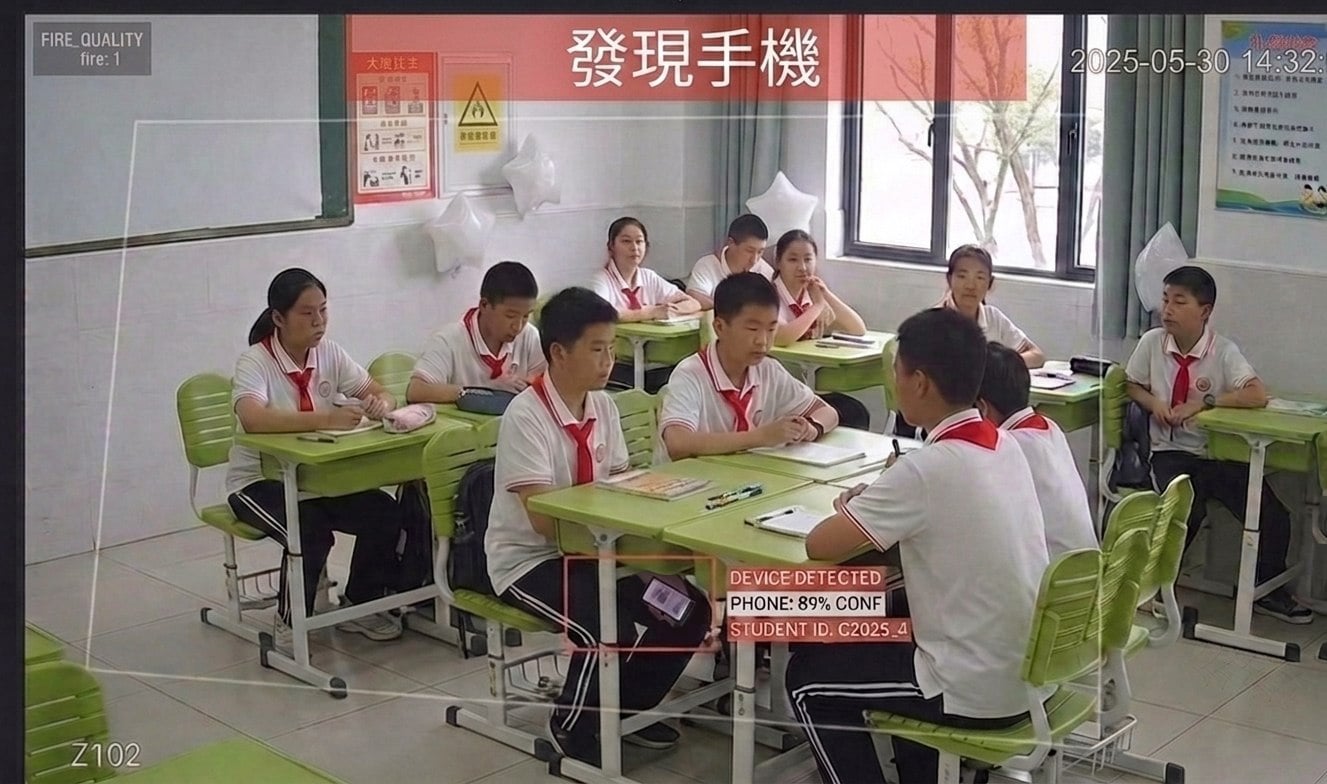
- Mobile phone usage control — recording phone use during class hours to maintain discipline.
Additionally configured:
- generation of alarm events upon violations with automatic notification to responsible staff;
- a simple monitoring dashboard for operators;
- adaptation of neural services to the specifics of the educational institution (camera angles, lighting, age characteristics of children).
Achieved results
- Technical feasibility confirmed — the system successfully detected target events on real video streams in the conditions of an educational institution.
- Security level improved — rapid alerts about fires, falls, and crowds allow staff to respond to incidents faster.
- Staff workload reduced — the system took over routine monitoring, freeing employees for other tasks.
- Foundation for replication created — the pilot project demonstrated the effectiveness of the solution and can be scaled to other educational institutions in China.