
Video analytics on fishing fleet vessels
n conditions of autonomous navigation and intensive work at the fishing grounds, the crew of fishing vessels faces high risks daily.
Project background
In conditions of autonomous navigation and intensive work at the fishing grounds, the crew of fishing vessels faces high risks daily: falls, impacts, getting caught in moving machinery, and adverse weather factors. Monitoring the use of personal protective equipment (PPE) — helmets and masks — was performed visually by watchkeeping officers, which was subjective and did not guarantee 100% coverage. In addition, ship surveillance cameras often failed due to vibration, salt fog, icing, or mechanical damage, leading to “blind” spots and reducing overall safety.
An automated solution was required for recognizing PPE usage by all crew members in hazardous areas (deck, processing plant, engine room), continuous monitoring of camera status to detect overexposure, lens obstructions, defocusing, and signal loss, immediate notification of the captain and security service about violations and technical malfunctions, as well as collecting incident statistics to improve the occupational safety system on the fleet.
Implementation progress
Specialists from OSMOVIEW LLC developed and implemented a solution for industrial safety control on fishing vessels based on the OSMOCV platform, adapted for operation in marine conditions. The platform is deployed on the onboard server of each vessel with power and data redundancy, with the possibility of remote access via a satellite channel for monitoring and updates.
Video streams from IP cameras installed in key production areas (deck, processing plant, engine room) were integrated into the platform, taking into account high humidity, vibration, and temperature fluctuations.
The solution includes in-house neural services developed by OSMOVIEW LLC:
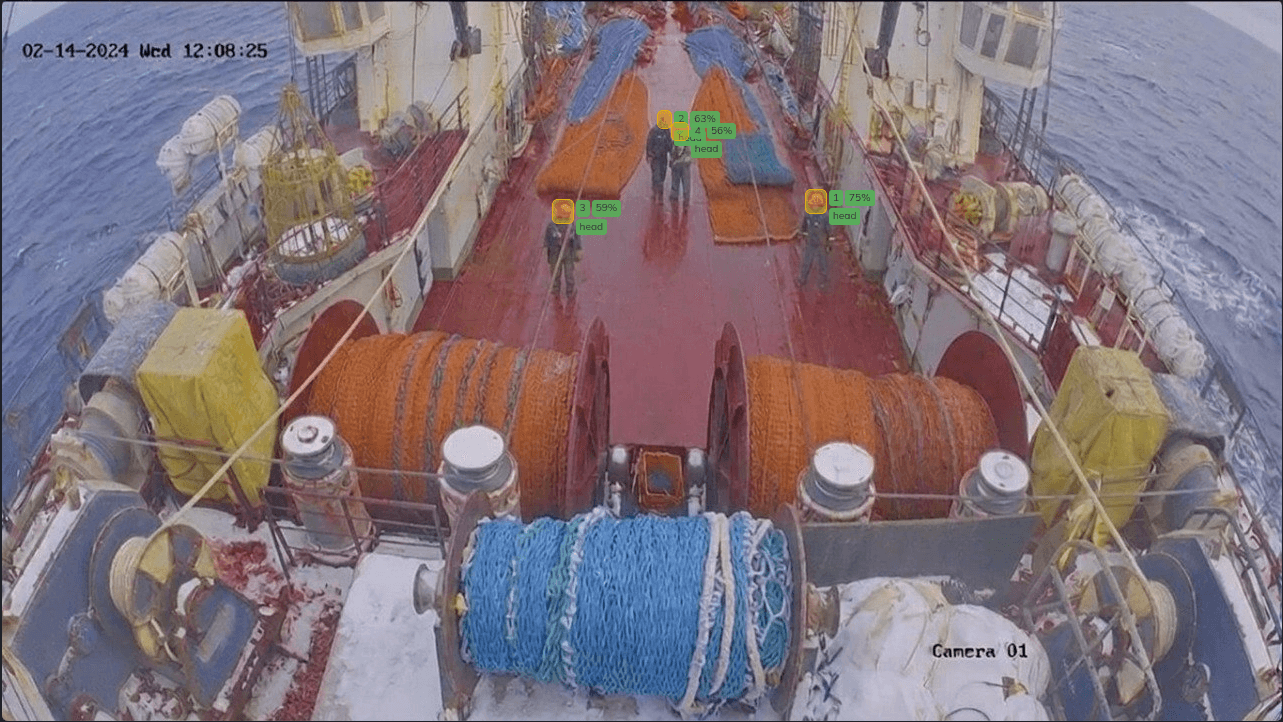
- PPE detection — recognition of helmets and masks on people's heads, taking into account various angles and lighting conditions in the presence of rolling and changing marine light;
- Camera service analytics — automatic analysis of the video stream for overexposure, lens obstructions (snow, ice, dirt), defocusing, and communication loss for prompt identification of malfunctions.
Additionally implemented:
- generation of alarm events in case of missing PPE or technical malfunctions, with notifications sent to the watchkeeping officer's tablets and the central control post;
- development of a data converter for transmitting metadata (PPE status, camera error codes) to the ship's violation and maintenance tracking system;
- creation of daily dashboards on PPE usage and camera “health”.\
Achieved results
- Crew safety level increased — more than 120 instances of being without a helmet or mask in hazardous areas were detected and prevented in the first 2 months of system operation.
- Downtime due to camera malfunctions reduced — service analytics allows for prompt (within 5–10 minutes) detection of overexposure, defocusing, or lens obstruction, and dispatching a repair team, which reduced video surveillance downtime by 80%.
- Objective PPE control ensured — manual checks were replaced by an automatic algorithm, which completely eliminates human error and improves crew discipline.
- Instant response ensured — notifications about violations or technical issues are transmitted via satellite communication even in remote fishing areas.
- Statistics and reporting formed — daily dashboards on PPE usage and camera “health” allow planning maintenance and conducting targeted briefings.
- 24/7 operation ensured — the system functions without interruptions and is resistant to rolling and temperature fluctuations.